) What was the name of the film made by Edwin S Porter that made use of a double-exposure to show a train window view of passing landscape?
2) Who invented the traveling matte shot in 1916?
3) How many weeks did it take to animate the main character in 1933’s KING KONG?
4) Which film made use of the ‘slit scan’ process in the 1960s?
5) In his essay “Industrial Memory” theorist Mark Dery argues that the silver fluid T1000 cyborg character represents a ‘masculine recoil’ – but from what?
6) Tim Recuber in his essay “Immersion Cinema” describes the key idea – that of immersion cinema itself – what is it? What makes it unique?
7) In the special effects history links, in the Time magazine history of special effects, there is a description of ‘motion control’ cameras developed for “Star Wars” in the 1970s. What is motion control?(1 paragraph)
8) Out of the 14 minutes of Jurassic Park’s dinosaur footage, how many minutes were computer generated imagery or CGI?
9) In the ‘denofgeek’ website, what is the name of the film that features an army of sword fighting skeletons, made in 1963?
10) In the ‘denofgeek’ site, which 2005 film used a special effects shot to sell the idea of a remake of a famous science fiction story to Steven Spielberg?
Wednesday, April 27, 2011

Tuesday, April 19, 2011
WEEK 11 DISNEYLAND!!!!!!!!!!!!!!!!!!!
1) In Margaret Crawford's Essay "The World in a Shopping Mall she outlines that 'the size and scale of a mall reflects "threshold demand"' - what is meant by this term?
In Margaret Crawford's essay she defines the term "threshold demand," as being the smallest potential number of customers within a given region that are willing to buy an item to generate profit. She goes on to explain the difference between neighborhood shopping centers, such as strip malls that have typical things such as a grocery store, a nail salon, a bank, a pharmacy, a doughnut shop and some other stores that can be found at any other shopping center. These centers typically have a crowd that is willing to travel about two miles on average to get to this center. Community centers are defended as being places where people are willing to travel three to five miles to make a purchase maybe there is an computer store here or a book store. Next is the regional mall, these malls are typical malls such as the "Stonestown Mall," or the Westfield Mall, where there are department stores, movie theaters, maybe around 100 shops and people are willing to travel on average of 25 miles to these places. Furthermore is the super regional mall, where people are looking for something extraordinary, such as the West Edmonton Mall, there are rides, wave pools, various attractions and maybe 300+ shops.
2) In the same article Margaret Crawford describes something called "spontaneous malling" - what does this mean?
Spontaneous malling is difference between actually going shopping to a mall as an activity to an experience that is omnipresent; it can take place almost anywhere. Designers and city planners can create "pedestrian zones" with nearby parking lots by blocking off areas of a city, "allowing the development of concentrated shopping."
3) According to Michael Sorkin in his essay 'See you in Disneyland', how did Disneyland have its origins?
According to Sorkin there are two myths regarding Walt Disney's ideas regarding the origins of Disneyland. The first is that in 1938 Disney visited the Chicago Railroading Fair where he was invited to drive a historic locomotive, it was doing this that the idea came to him. The Disney Family also visited an unconventional theme park that lacked organization and good hygiene. Therefore Disney wanted to recreate this idea as a utopia in what was once an orange grove in southern California.
4) Michael Sorkin writes in his essay that Disney's EPCOT Center was motivated largely by frustrations Disney felt at his Anaheim CA park. What were those frustrations?
Disney was frustrated by the developments around Disneyland; therefore he relocated in secrecy to Florida in order to create everything without other developers knowing. He was able to create a greater utopia encompassing the customers with it's own hotels and businesses instead of other businessmen's ideas.
5) In his essay "Travels in Hyper reality" Umberto Eco describes Disneyland as 'a place of total passivity' - what does he mean by this?
Umberto Eco describes Disneyland of a place where consumers are not able to have any other option but the "utopian," option Disney offers. Consumers are not able to escape the game without playing it, or paying for it, "they must agree to behave live its robots." Railings directing visitors to a new location, a new store, or a new ride always interfere with the individual’s decisions; there is no void of indecision.

WEEK 11 DISNEYLAND!!!!!!!!!!!!!!!!!!!
1) In Margaret Crawford's Essay "The World in a Shopping Mall she outlines that 'the size and scale of a mall reflects "threshold demand"' - what is meant by this term?
In Margaret Crawford's essay she defines the term "threshold demand," as being the smallest potential number of customers within a given region that are willing to buy an item to generate profit. She goes on to explain the difference between neighborhood shopping centers, such as strip malls that have typical things such as a grocery store, a nail salon, a bank, a pharmacy, a doughnut shop and some other stores that can be found at any other shopping center. These centers typically have a crowd that is willing to travel about two miles on average to get to this center. Community centers are defended as being places where people are willing to travel three to five miles to make a purchase maybe there is an computer store here or a book store. Next is the regional mall, these malls are typical malls such as the "Stonestown Mall," or the Westfield Mall, where there are department stores, movie theaters, maybe around 100 shops and people are willing to travel on average of 25 miles to these places. Furthermore is the super regional mall, where people are looking for something extraordinary, such as the West Edmonton Mall, there are rides, wave pools, various attractions and maybe 300+ shops.
2) In the same article Margaret Crawford describes something called "spontaneous malling" - what does this mean?
Spontaneous malling is difference between actually going shopping to a mall as an activity to an experience that is omnipresent; it can take place almost anywhere. Designers and city planners can create "pedestrian zones" with nearby parking lots by blocking off areas of a city, "allowing the development of concentrated shopping."
3) According to Michael Sorkin in his essay 'See you in Disneyland', how did Disneyland have its origins?
According to Sorkin there are two myths regarding Walt Disney's ideas regarding the origins of Disneyland. The first is that in 1938 Disney visited the Chicago Railroading Fair where he was invited to drive a historic locomotive, it was doing this that the idea came to him. The Disney Family also visited an unconventional theme park that lacked organization and good hygiene. Therefore Disney wanted to recreate this idea as a utopia in what was once an orange grove in southern California.
4) Michael Sorkin writes in his essay that Disney's EPCOT Center was motivated largely by frustrations Disney felt at his Anaheim CA park. What were those frustrations?
Disney was frustrated by the developments around Disneyland; therefore he relocated in secrecy to Florida in order to create everything without other developers knowing. He was able to create a greater utopia encompassing the customers with it's own hotels and businesses instead of other businessmen's ideas.
5) In his essay "Travels in Hyper reality" Umberto Eco describes Disneyland as 'a place of total passivity' - what does he mean by this?
Umberto Eco describes Disneyland of a place where consumers are not able to have any other option but the "utopian," option Disney offers. Consumers are not able to escape the game without playing it, or paying for it, "they must agree to behave live its robots." Railings directing visitors to a new location, a new store, or a new ride always interfere with the individual’s decisions; there is no void of indecision.
Thursday, April 7, 2011
MIND MAP
This is a copy of my mind map, it is too large to take a photo of and succesfully upload so I am a bit confused. However I read the articles and here it is.

Thursday, March 24, 2011
SECOND LIFE
1) The social life in Second life seemed as if it were a more personally subjective social media meeting place as opposed to something such as Facebook or Myspace. The reason being is that reality doesn't effect your social experience because you can create the person and world that you desire. As opposed to the one given or inherited, which turns up in social media sites.
2) People converge in different meeting places in Second Life or simply by just walking around and talking to someone. The purpose seems similar to Google SketchUp, however within Second Life there seems to be a real community in which people share ideas, designs, or inner personalities.
3) I found the game to be relatively easy to control my characters behaviors, I can be friendly and just cruise around or I can aggravate people. I found that other people in Second Life were relatively friendly, I interviewed someone named El Rijj about their take on the game and why they like it, therefore It seemed that the behavior of the people in Second Life was pretty accommodating.
4) People that I imagine are most attracted to SL are people who enjoy gaming, designing, or escaping reality for a better life. I believe this, because within the game, I was able to leave my tiny apartment and freely navigate around a beautiful scenario, escaping my feelings, bad weather, and pathetic savings.
5) I'm pretty sure you can buy nearly anything you want in SL, Five things I saw were,
- Mens clothing, I saw a mens jacket called the Alphamale, black for L 485
- Art, I saw a sculpted Lion called Panthera Leo, for L750
- You can buy aircrafts, this week a Kinoshita from SF labs was for sale for L4,499, or L1000
- I different vehicles for sale, this week there was a 1968 Ford Mustang for L2000
- I even saw a private island for sale this week, one in particular was Commercial City Island, and I think it was free because it said L0.
8) List five people you met online per week and a) who they were and b) what they hope to get out of SL and c) how did they view you?
- El Rijj, he was a gothic avatar, he liked playing the game because he could create a world of his own despite having little money in real life. He thought it was pretty cool that I was able to play the game for a class, I told him I was doing research at SFSU for a digital media history class.
- The next character I interviewed was , Donatien Alphonse Francois, he plays because "I like it because it is a way to escape real life[13:44] donatienbathori: it's not that MY life is bad [13:44] donatienbathori: but I find that the real world can't entertain me very much [13:44]donatienbathori: is so tedious, and vulgar"
- I then interviewed someone names Shifty Gears, who was not very nice, I nicely asked why play and they said to escape reality as well as their life sucks, the interview was quick and rough.
- I then interviewed someone named Mal Swords who said they play because of the cultural diversity as well as escaping reality. They talked about how one can be anywhere in the world and play with character anywhere else in the world, its a way to "connect with others and get close to foreign cultures." The interaction was relatively negative.
- I then interviewed someone in french name Liotta Vin, This person enjoyed playing because of SL's ability to create anything from nothing, and escape the day to day. You can build without restriction, there is no torture, pollution, or pain. No suffering in SL
- It seemed everyone used this program simply to escape reality.
9) I only had one negative interaction with someone on the game, Mal Swords, other than that people were ecstatic to find that I was playing for school. As well as doing research regarding possibilities as well as why others play.
10) People in SL are employed to make SL currency or they spend their real money in the game. There are virtual Stores where items are either free or for sale, people can also create their own things and sell them.
11) It seemed that the SL economy was way better than the real economy, for two reasons, One, you can buy pretty much anything, and the second is that money doesn't define your life, but your desire to create and be creative, also the economy isn't failing!
12) If a person wants to live in a gothic medieval world they can, they can have wings and fly around, they can even date. Therefore it seems that people are able to pretty much do anything their innerself want but their reality restricts such as money, up bringing, or race.
13) It seems that on the outside it's like a very very friendly mall, however I believe that people can get very close an intimate and create very intimate relationships. The game is very informal, I believe this because of the way I was causully able to interview people unlike in the real world peoples egos seem to shape them.
14) The rituals of everyday life were pretty similar to that of real life, people have property, shelter, a job, relationships.
15) I had a pretty positive experience once I had told people that I was a student doing research, however if I didn't tell them that it seemed that they assumed I was a Newb and they wouldn't really acknowledge me.
16) I would say that people are almost more friendly in SL than in real life. People seem very honest with their replies and they don't have tones of voices.
17) From the point of a researcher, I learned that people use second life in order to interact in a vital world, leaving the real world behind and only taking certain elements of it. People come from all parts of the world and background, people are of all ages and occupations, and none of this information defines who they are in SL. It's as if people are over the trails and tribulations reality and are entering a matrix.

Thursday, March 17, 2011
WEEK 7 Questions!
1) Who invented the first computer game on the PDP1?
Steve Russell was the first computer game inventor on the PDP1.
2) What was the name of the game?
The game he created was Spacewar!
3) What was the name of Morton Helig's amusement device that let you smell, hear and see in 3D filmed experiences?
Morton Helig is responsible for creating the Sensorama!
4) What early 1970s movie does an arcade console machine of Spacewar appear?
Spacewar was seen in the film Soylent Green in 1973.
5) What was the name of the man who developed the first TV tennis game?
Ralph Baer is the name of the man who first developed TV tennis.
6) Who was the man whose company Atari commercialized the idea of the arcade computer tennis game?
Nolan Bushnell was the name of the man who founded Atari.
7) What was the name of this version of the game?
Pong was the name of his version of the game.
8) What are vector graphics?
Vector graphics are graphics that are based off of mathematical equations regarding geometry that display beams of light on the screen that constantly update themselves so the images on the entire screen can quickly appear live.
9) What types of games do vector graphics lend themselves to?
Vector graphics primarily lent themselves to games that were based on mathematical equations such as shooters where precision and quick responsive movement was key to seem real. Detailed static backgrounds also could be shown where the live images could be simple and quick to move.
10) When home computers were first made available, how did owners load games into them?
The first owners of computers had to load games onto by typing the game codes themselves. These codes were distributed by groups of enthusiasts as well as through early publications. They also loaded them using cassette tapes and later floppy disks.
11) What is the name of the 1985 film in which a young Matthew Broderick starts World War III with his home computer and modem?
In the film WARGAMES, Matthew Broderick starts WWIII by hacking on his home computer.
12) From what sources did the designer of the Space Invaders aliens draw inspiration?
An early adaptation he had seen of H.G. Wells "War of the Worlds" was the early inspiration of the game Space Invaders.
13) What is the name given to the contemporary subculture of 8 bit music made with gameboys and other 80s game technology
Chiptunes!
14) "Escape from Woomera" was a videogame which was used to draw attention to the plight of inmates at a remote detention center in desert town in what country?
Australia is the country where the prison that "Escape from Woomera" is based off.
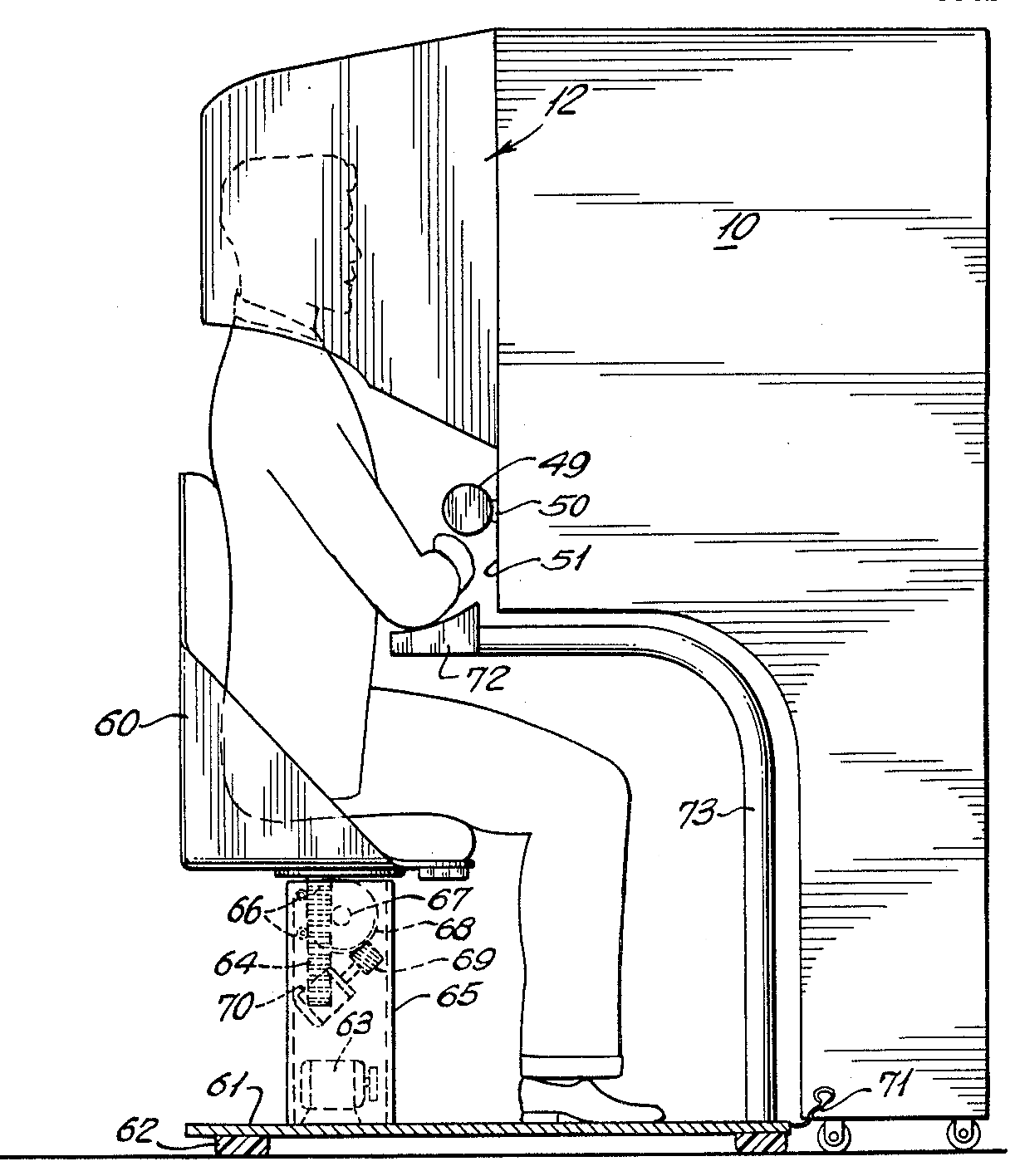
-Sensorama Patent
Thursday, March 10, 2011
WEEK 6 QUESTIONS
1) Steve Mann describes his wearable computer invention as a form of architecture for one person.
2) Steve Mann's concept of opposing camera surveillance with "Sousveillance" is described as a form of “reflectionism,” or "inquire -in-performance." Steve Mann's idea of "reflectionism" is best described is best described as a way of surveilling the surveyor. After all if we established the establishment we should be able to created a mirrored image of itself to keep itself in check. If we survey the surveyor we are able to get what we want because after all it is supposed to be a democracy not a police state.
3) Steve Man Talks about hidden cameras becomes more complexed if used in places that are more surveilled or "semi-public," such as malls. He then goes on to talk about how on the street, in public people become immersed in the playfulness of the camera and don't really mind being filmed whereas in more private places or "semi-public," people reacted much harsher and confrontation was much more prominent.
4) The final paragraph sums up what Mann considers the benefits of "sousveillance" and "coveillance". The benefits are such ways of "surveying the surveyor," or keeping the establishment in check. Since the dawn of surveillance technology, the use has been primarily one-sided, therefore Mann suggest the use of portable surveilling technology enables individuals membranes of the larger network to unite and strategies against the lack of protection given by the surveyors.
5) In William J Mitchell's 1995 book "City of Bits" in the chapter "Cyborg Citizens", he puts forth the idea that electronic organs as they shrink and become more part of the body will eventually resemble clothing and eventually be woven into the fabric of cloth.
6) A vehicle that knows where it is will able able to do quite a bit Mitchell list quite a few, such as, commentary on local history and listed agricultural products of an area.
7) Mitchell tells the story of Samuel Morse's first Washington-to-Baltimore telegraph message was, "what hath God wrought."
8) Donna Harroway in "A Cyborg Manifesto" argues that women should take the "battle to the border". Donna talks about what is at stake in this battle, things such as "…territories of production, reproduction, and imagination." These a extremely significant things at stake for women because Donna argues that they need to be heard and a utopian world with a one gender society is not possible.
9) The Utopian dream the Harroway is talking about is of a utopian genderless future society. A society where gender is completely transparent and not an issue. She suggest that gender isn't thrown out, but overtime dropped from society.
10) I do believe that we are cyborgs, this is because of the type of technologies we use effortlessly and dependently daily. I wake up depending on an alarm clock, can interact with people far away live, on a cellphone, and I get around the city depending on traffic lights, MUNI times, and other machines that are extensions of human desire. I have thought of humans as cyborgs since I first saw the first blue tooth cellphone devices. It was as if people we telecommunicating, lost in the matrix, or completely insane. I believe that the more we urbanize the more we become cyborgs because of our dependency on technologies.

Subscribe to:
Posts (Atom)